How to Find Cheap Hotels Without Getting Scammed: 15 Safe Booking Tips for Travelers
Introduction: Your Wallet Is Smarter Than You Think — Until a Scammer Shows Up
Let me paint you a picture. You finally book that trip you’ve been dreaming about for months. You find a suspiciously great hotel deal online — like, suspiciously great. Beautiful photos, five-star reviews, a price that makes you do a double-take. You pay. You show up. And the front desk has never heard your name.
Sound dramatic? It happens more than you’d think.
Here’s the truth: knowing how to find cheap hotels without getting scammed is genuinely one of the most underrated travel skills out there. And it’s not just about avoiding “fake hotels.” Scams today are sophisticated — fake booking websites that look almost identical to the real thing, phishing messages dressed up as official reservation confirmations, hidden resort fees that quietly double your bill, and fake reviews designed to make a sketchy motel look like a boutique resort.
The good news? You can absolutely find cheap hotel deals safely — you just need to know what you’re doing. Let’s break it all down.
The 6-Step Safe Hotel Booking Process
Before we dive into tips, here’s the process I recommend every time — whether you’re booking a $40 hostel or a $200 resort:
- Search on Google Hotels, KAYAK, Trivago, or Tripadvisor to get a baseline price
- Compare that price with the hotel’s official website
- Check reviews on at least two different platforms
- Confirm the full price — taxes, resort fees, service charges included
- Pay only through the official booking platform or verified hotel website
- Ignore any urgent messages asking you to pay outside the platform
That’s it. Simple? Yes. But most people skip steps 2, 4, and 6 — and that’s where it gets expensive.
How to Find Cheap Hotels Safely: The Best Booking Sites to Use
Start with a Price Comparison Tool
The smartest thing you can do when looking for cheap hotel deals is not to book the first thing you see. Start with comparison tools instead.
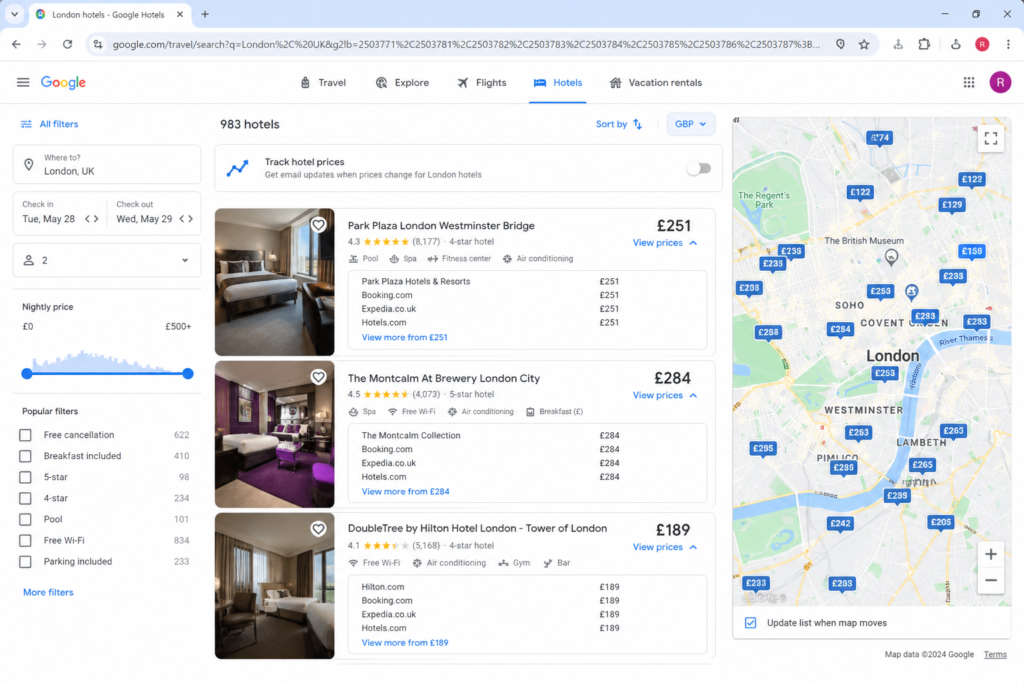
Google Hotels is my personal starting point every single time. It pulls prices from multiple platforms, shows ratings, lets you filter by neighborhood, and even tracks price trends. It’s free, easy, and gives you a realistic picture of what a fair price looks like for any destination.
KAYAK and Trivago do something similar — they compare prices from Booking.com, Expedia, Hotels.com, and others all at once. Think of them as the “sanity check” tools. If a price looks way too low on one booking site but normal on Trivago, that’s worth noticing.
Tripadvisor is invaluable for review checking before you book anywhere. They also have a section specifically on recognizing scams impersonating their own platform — worth bookmarking.
Best Booking Platforms for Budget Hotels
Once you’ve compared prices, here are the platforms actually worth booking through:
- Booking.com — Massive inventory, good filters, strong cancellation options. A critical note: Booking.com specifically warns users never to send payments outside the stated booking policy. If anyone messages you asking to pay via bank transfer or gift card, that’s a scam.
- Agoda — Great for Asia and international budget deals. Often cheaper than Booking.com for the same property in Southeast Asia.
- Hotels.com — Good for rewards through the One Key ecosystem (shared with Expedia and Vrbo). Every booking earns OneKeyCash you can use on future trips.
- HotelTonight — Genuinely solid for last-minute hotel deals. Same-day bookings only, but the prices can be surprisingly low for good properties.
- Hostelworld — If you’re backpacking or solo traveling on a serious budget, Hostelworld is the go-to. Reviews are community-driven and generally reliable.
- Priceline — Great for deal hunters in the US market, but read the cancellation rules carefully before you pay. Some deals are non-refundable.
💡 Pro Tip: Always cross-check your final pick between at least two platforms — Google Hotels and the hotel’s own website. Direct booking sometimes gives you a better price, free upgrades, or more flexible cancellation terms.
How to Avoid Fake Hotel Booking Sites
This is where most people get burned. So let’s talk about how to spot fake hotel booking websites before you hand over your credit card.
Red Flags to Watch For
- URL looks slightly off — “b00king.com” instead of “booking.com,” for example. Always look closely at the address bar.
- No HTTPS / padlock icon — Legitimate booking sites use encrypted connections. No padlock? Close the tab.
- Prices that seem impossible — A 4-star hotel in Miami for $35/night in peak season isn’t a deal. It’s a trap.
- Payment requested outside the platform — This is the biggest one. Any message asking you to pay via wire transfer, cryptocurrency, or gift cards is a scam. Full stop.
- Urgency pressure — “Your reservation expires in 10 minutes!” is a classic phishing tactic. Real booking platforms don’t work like that.
- No physical address or customer service number — Legitimate sites have contact info. Fake ones hide it.
How to Spot Fake Hotel Reviews (This One’s Sneaky)
Fake reviews are absolutely a thing, and learning to spot them is one of the best safe hotel booking tips I can give you.
Signs a Review Might Be Fake
- Too many 5-star reviews with no details — “Amazing! Great hotel! Loved it!” over and over, with no specifics.
- Reviews all posted around the same date — A wave of glowing reviews that all appeared last month? Suspicious.
- No negative reviews at all — Every hotel has some unhappy guests. Zero complaints usually means filtered or fake reviews.
- Reviews that mention a different hotel name — Sometimes fake listings copy reviews from real properties.
My recommendation: Check reviews on at least two platforms. If a hotel looks great on Booking.com but has mixed reviews on Tripadvisor? Trust the mixed ones.
The Hidden Fee Problem Nobody Talks About Enough
Here’s a fun scam that isn’t technically a scam — it’s just deeply annoying and increasingly common. Hidden resort fees and mandatory charges that don’t show up until you’re checking out.
The FTC now has rules requiring clearer disclosure of mandatory fees for short-term lodging, which took effect in May 2025. But even with that rule in place, you still need to check the total price including all fees and taxes before you compare anything.
How to Avoid Hidden Hotel Fees
- Always click through to the final checkout page to see the complete cost before comparing deals
- Look for “resort fee,” “amenity fee,” “destination fee,” or “service charge” in the fine print
- Use Tripadvisor or Google Hotels which sometimes surface total prices including fees
- Book directly with the hotel when fees are unavoidable — at least you can call and negotiate
Are Last-Minute Hotel Deals Safe?
Honestly? Yes — if you use the right platforms. Last-minute hotel deals are usually legitimate because hotels would rather fill a room at a discount than leave it empty.
HotelTonight is the best dedicated last-minute platform. Deals are verified, properties are vetted, and the app is clean and easy to use.
The risk with last-minute deals isn’t the platform — it’s the urgency. When you’re desperate for a room and a random pop-up ad promises a 70% discount, that’s when people make bad decisions. Stick to well-known platforms even when you’re booking at the last minute.
Should I Pay With a Credit Card for Hotel Bookings?
Yes. Always. Without question.
Paying by credit card gives you chargeback protection, which means if your reservation turns out to be fake or the hotel isn’t as described, you have a real path to getting your money back. Debit cards, wire transfers, gift cards, and cryptocurrency offer zero protection.
For international bookings, the Wise Card is excellent — it converts currency at the real exchange rate with minimal fees, so you’re not accidentally paying 3–5% extra just to book a hotel in Europe.
If you want an extra layer of protection, tools like Privacy.com let you create virtual card numbers for online purchases. If a sketchy site somehow gets your card number, they can’t charge more than you allow — or use it elsewhere.
Book Direct vs. Third-Party: Which Is Actually Better?
This is the great debate of travel booking, and honestly, the answer is: it depends.
| Factor | Book Direct | Third-Party (Booking.com, Expedia) |
|---|---|---|
| Price | Sometimes cheaper (no commission) | Often competitive, easier to compare |
| Flexibility | Hotel can adjust reservations easier | Platform policies may apply |
| Rewards | Hotel loyalty points | Platform cashback/points |
| Scam risk | Lower (you’re on the official site) | Medium (verify the platform) |
| Free cancellation | Usually available | Check policy carefully |
My personal approach: search on third-party sites to find the best options, then check the hotel’s direct site for the final price. Sometimes direct is cheaper. Sometimes it’s not. But at least you’ll know.
Top Tools to Save Extra Money After Booking
Found your hotel and ready to save a little more? Try these:
- Rakuten — Cashback on travel bookings through supported partners. Stack this with a good credit card and you’re essentially getting paid to book.
- Hotwire — “Mystery hotel” deals that can be significantly cheaper, but read the restrictions carefully. Non-refundable bookings are common.
- Skyscanner Hotels and Momondo — Good supporting comparison tools, especially if you’re also searching for flights.
FAQ: How to Find Cheap Hotels Without Getting Scammed
How can I find cheap hotels safely online? Use price comparison tools like Google Hotels or KAYAK first, then verify the price on the hotel’s official site. Always pay through established platforms with buyer protection.
What is the safest website to book cheap hotels? Booking.com, Expedia, and Hotels.com are among the most established. For last-minute deals, HotelTonight is reliable. Always use platforms with clear cancellation policies and secure payment systems.
How do I know if a hotel booking website is fake? Check the URL carefully, look for HTTPS, search for the site on Google with “reviews” or “scam” added, and verify it has working customer service contacts before paying.
Is it better to book directly with the hotel or through a booking app? Both can work. Booking direct sometimes offers better prices or perks; third-party sites make comparing easier. The safest approach: compare both before deciding.
How can I avoid hidden hotel fees? Always view the full price breakdown before booking. Look for resort fees, destination fees, and service charges. The FTC now requires clearer disclosure of mandatory fees for lodging.
Are last-minute hotel deals safe? Yes, when booked through reputable platforms like HotelTonight. Avoid flash-sale pop-ups from unknown sites.
What are the most common hotel booking scams? Fake booking websites, phishing messages that impersonate real platforms, urgent payment requests outside the official site, inflated prices with hidden fees, and fake reviews.
How do I check if hotel reviews are fake? Look for patterns: clustered posting dates, vague language, no negative reviews, or reviews mentioning a different hotel name. Cross-check on at least two platforms.
Should I pay for a hotel before arrival? Pre-payment is normal and fine on reputable platforms. Never pay via wire transfer, gift card, or cryptocurrency — these are scam methods.
What should I do if my hotel reservation turns out to be fake? If you paid by credit card, immediately contact your bank to dispute the charge. Report the scam to the FTC at reportfraud.ftc.gov and to the platform where you found the listing.
Conclusion: Budget Travel Is Smart Travel — Just Don’t Skip the Safety Steps
Knowing how to find cheap hotels without getting scammed isn’t rocket science, but it does require a little patience and attention. The process is simple: compare prices, verify the site, check reviews across platforms, confirm the total cost, and always pay through a trusted platform.
The internet is full of incredible hotel deals — genuinely cheap, genuinely safe ones. You just have to know where to look and what to avoid. Use the tools above, follow the six-step booking process, and pay with a credit card. Do those things, and you’ll be checking into your budget hotel without any nasty surprises at the front desk.
Now go plan that trip. You’ve got the tools. You’ve got the knowledge. There’s no excuse to overpay — or get scammed — ever again.
Found this guide helpful? Share it with a friend planning a trip, or bookmark it for your next booking session. Safe travels.
Disclosure: Some links in this article may be affiliate links. If you book through them, we may earn a small commission at no extra cost to you. We only recommend services we genuinely trust and use.